How My Career Has Prepared Me To Lead Toronto
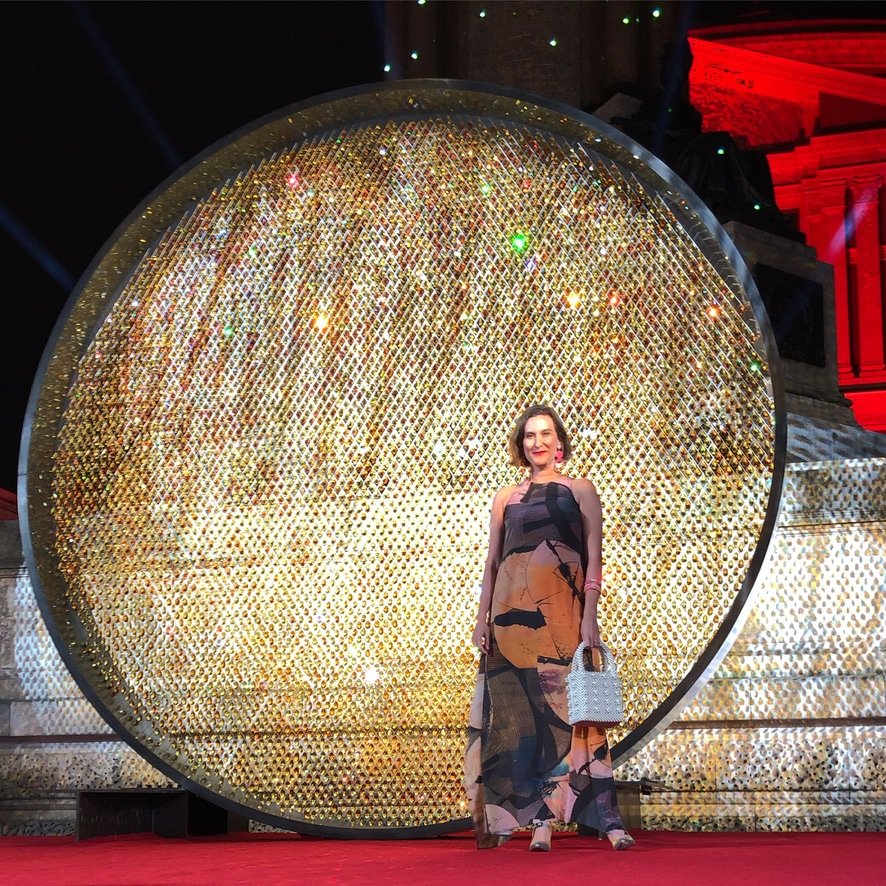
Attending the Fashion Awards in London, 2018. I’m wearing a dress by Jeremy Laing and earrings by Warren Steven Scott, two of the talented local creatives I’ve had the pleasure of knowing for years.
“What's the connection between being a fashion editor and being the Mayor?”
I've been asked this question a couple of times, and I wanted to speak a bit about how my experience and skill set would be an asset in the role of Mayor. Through my journalism I’ve been an ambassador and advocate for Toronto’s unique cultural sector while working abroad, as well as a champion for designers, artists, entrepreneurs and more here at home.
There are many learnings from these experiences that I can apply to leading the city, including how to build lasting and trusted relationships with community members, and how to perpetually evolve the opportunities in which the work of Torontonians can inspire their neighbours as well as influence international markets.
I recently had a phone call with a group of women who work with designers and architects. They’re interested in helping me with my campaign because they know I’m passionate not only about advocacy and storytelling to galvanize local consumers, but also in devising how to bring “Brand Toronto” to a worldwide audience. We have so much to be proud of here and working on new and novel ways of supporting our economy-driving cultural sector can truly be a way forward in terms of Toronto fortifying itself against external political meddling.
On this note, I’m finding a lot of inspiration from fashion editor and CEO of London Fashion Week, Laura Weir, and how she’s spearheading impressive actions to bolster the British fashion industry as its recognized as a vital and lucrative industry. In contrast, the current City of Toronto “Culture Connects” project document that was released earlier this year specifically omits “fashion” from what is considered “culture”. Yikes!
Practically speaking, during my time founding and managing the production of two independent cultural, locally focused publications – and subsequently developing and directing the Vintage Crawl Toronto events – I have worked with BIAs, organizations such as Magazines Canada, and business owners across the city to bring various community projects to life.
I also proposed and led the development of a fashion business program for Centennial College, the intention of which was to prepare graduates for a career in the fashion industry outside of the designer role. It was the first and only of its kind, and I was very proud to be able to provide my insight from collaborating with various emerging designers and knowing their specific pain points being based here.
And that’s what I believe the most crucial career-cultivated asset to my “mayoral fit” is: How much I've listened to and learned from Torontonians. They have been so generous in sharing the wins and challenges in residing and working in Toronto; I want to apply what I know – always wanting to know more! – to ensure the stability and growth of our local economy, and to place us as a leader in cultural development and innovation. Not only that; my ideas are also integral to supporting climate action initiatives and social services, as you’ll see below.
Additionally, the opportunities to cover events such as the Yukon Art Prize in Whitehorse, Art Basel in Switzerland, and Zona Maco in Mexico City, have allowed me to glean perspective into how other large, growing and fellow Canadian municipalities can function well, if not impressively!
Read on to find out what I’ve learned from creative founders and visits to cultural capitals with regards to issues from sustainability and economic empowerment, to brand building that endeavours to bolster municipal pride and drive visionary local business leadership.
What’s Now, What’s Next?
As much as I possibly could in my years of being both on mastheads and freelancing in the fashion world, I’ve managed the professional expectation of an editor to be in constant pursuit of the new with a personal sense of intentionality. I’ve chosen to focus on featuring creatives who have practices centered around responsible, delightful and unique approaches to making. For example, I once wrote about a London-based brand that makes its apparel from an edible gelatin material, and I’ve covered Canadian designer Olivia Rubens’ biotech garments and accessories.
HOW DOES THIS RELATE TO MY PLATFORM?
· I want to support the growth of a local life sciences sector through the Toronto Prosperity Tax and collaborations with Bay Street leaders
o Builds the local workforce and establishes a new local economy
o Builds Brand Toronto (why should K-Beauty get all the glory when we have amazing local skincare companies, for example?)
The Eye Has to Travel
Toronto has been my home for my entire life, and I’ve witnessed the profound changes to our landscape and spaces from Scarborough to Etobicoke, the Lakeshore to North York. I’ve also had the great fortune to visit incredible cities such as London, New York, Paris, Mexico City on numerous occasions – each trip allowing me to further discern how these iconic metropolises manage to captivate both citizens and visitors as time goes by.
Most crucially, in my opinion, is that each place has its own municipal personality and a sense of pride attached to it. Let’s take the last time I was at London Fashion Week earlier this year, when a morning amble down Savile Row as London started its day illustrated how a simple act of visibility makes a big impression.
As you pass by the vaunted location’s tony tailoring showrooms – still closed at that time of day – the basement ateliers are beginning to hum. While other Londoners head to work with a quick glance downward to be reminded of the beauty of this chaotic city, and as tourists lug their suitcases past these subterranean scenes, a quick jolt of interest takes over walking by the illuminating windows: Oh ya, they make nice suits here, and I ascribe value to that because I can see the labour behind it.
Another way in which I’ve witnessed value be assigned to local products is exceptional retail design. From the luxury perfumer Xinu’s tantalizingly esoteric boutiques in Mexico City to the Dries Van Noten shops in Paris, I’ve seen the impact – both within civic pride and tourism appeal – that thoughtful and dynamic design has on a city’s economy. We have our share of well-considered retailers here, and I want to build on that!
HOW DOES THIS RELATE TO MY PLATFORM?
· I want to develop a plan for a “makers district” where people can see our local goods come to life
· I want to augment and re-focus the City’s current Shop Local support efforts to include rebates for Toronto’s citizens to buy locally made products and incentives for businesses to carry locally made goods, as well as launch a service assisting local businesses to develop unique loyalty programs for locals and tourists and navigate processes like getting permits for events
· I want to support local retail and brands through the Toronto Prosperity Tax to incentivize store design and inter-province/territory collaborations in design, sustainable small-scale urban production, and natural textile manufacturing
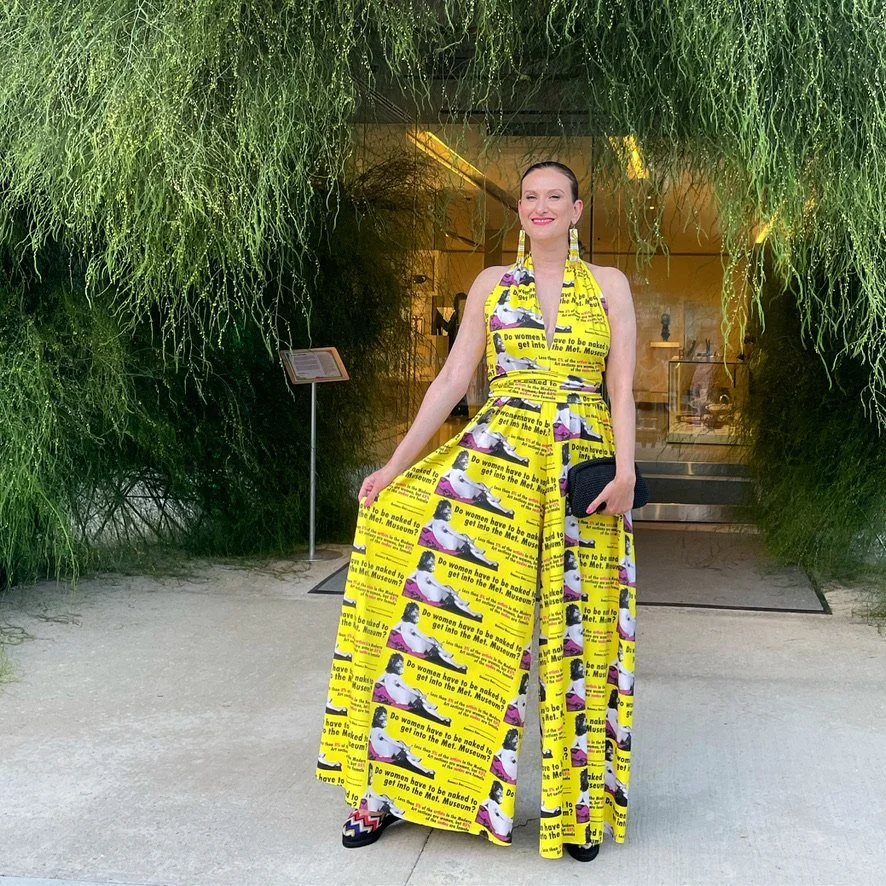
Me in a custom jumpsuit by local entrepreneur Alexis Venerus of Sew Rite Studio. The print is from the Guerrilla Girls’ Met. Museum piece.
Admiration for Craft
My career as a cultural journalist has given me more opportunities to champion local entrepreneurs in more ways than one. When I co-chaired the Gardiner Museum’s SMASH event a few years ago, I knew I wanted my outfit to be special. I chose to have something made by a local patternmaker and seamstress using an old pattern that my grandmother made clothing for my aunt and mum from.
For the fabric, I wanted to use the iconic MET. Museum work by anarchist art group Guerrilla Girls. Alexis Venerus, the seamstress, suggested an Ontario-based company that would print fabric for me, and I actually managed to have the Guerrilla Girls send me a high-res image of their work for a (very affordable!) donation to their advocacy efforts. They were super into the idea!
From there, Alexis created an incredible jumpsuit that not only caught the eye, but gave me a story to tell – the story of how my dad explained the concept behind this artwork when we were at the AGO many years ago. That conversation sparked my fledgling feminism and also demonstrated to me the social impact of culture; not to mention the fact that I got to say I worked with a local creative on the piece.
Now, Alexis owns a small-scale production studio on Dundas Street West employing full and part-time employees as well as students. I visited a few months ago and was blown away to see how many orders the team were working on; I want to see businesses like this everywhere in Toronto.
Plus I find it fascinating that it used to be completely common practice for people to make their own clothing; I mentioned my maternal grandmother earlier, and she – along with, I’d argue, a disproportionate number of immigrants to Canada – sewed their own stuff without a second thought. I want to bring that practice back through the launch of programs dedicated to training and skill-building with relation to textile craft, as well as a subsidy for Toronto-based fashion brands to develop patterns for people to use to make their own garments and accessories. The New York-based brand Adiff launched an “open source” fashion book a few years ago with pattern designs by a host of cool designers, and I think we could lead with a city-wide pattern draft (pun intended). What better way to define Toronto’s fashion identity, after all?
Note: If you’re wondering how I met Alexis, it was through her working at Comrags – the amazing Toronto fashion brand that closed last year. Alexis and I both worked in the store – me much earlier than her, and we became friends. I followed along as she did some work for another excellent local fashion creative, Warren Steven Scott. And when Comrags closed, Alexis was able to take her emerging studio, called Sew Rite, and set up operations in the second-floor space that Comrags once occupied. I love to see it!
HOW DOES THIS RELATE TO MY PLATFORM?
· I want to develop textile craft product facilities in all 25 wards akin to Stitch Buffalo geared towards skill training and skill leveraging for newcomers – specifically refugees, women and youth – that has a retail component to foster financial independence and create spaces
· I want to ban pop-up presence from brands such as Shein
Attuned to Lip Service
As you can imagine, I’ve dealt with my fair share of wildly out of touch, nefarious pick-me people, and I now have a tight BS detector when it comes to things like greenwashing and other empty gestures.
HOW DOES THIS RELATE TO MY PLATFORM?
· I want to review and revamp the public consultation processes currently used by the City to ensure there is meaningful dialogue, education and action with relation to the visibility and prosperity of people in marginalized communities across the city
· I want to overhaul the way the City communicates with the public to provide clarity and responsible messaging, including wayfinding and public safety measures
· Rather than take down historical markers such as statues – which would cost money anyway, and essentially satisfies nothing with regards to strides in ending racism and other expressions of bigotry and colonialism – I want to develop a public art program called “Interventions” that engages with local artists and curators to create artistic informational responses to these objects in order to boldly, adequately and fairly represent our local history and its figures
Championing Storytelling at the Grassroots Level
I launched my first e-zine, called Celery, at the end of my undergrad; it was focused on highlighting Toronto-based fashion, visual art, music and more. Years later came Plaid, a publication that was eventually sold at major magazine retailers across the country (as well as local spots, of course); its content was largely the same, and it’s how I met so many of the stellar creatives, from stylists and photographers to illustrators and editors, that I still call friends today.
It’s through these deeply personal and DIY experiences, combined with my time on mastheads for a national newspaper and fashion publication, that I’ve come to know so much about the realities of being a local creative; and I would fully support the creation of unions for artists of all kinds.
Additionally, no one has a better grasp than I do in terms of the dramatic and hugely affecting shifts in independent and local media in Toronto in the past two decades, in addition to the continually changing global media industry. Along with crafting clearer and more relevant communications strategies from City Hall itself, I intend to nurture a thriving local media industry, through investment and mentorship programming partners, that rallies and inspires Torontonians for years to come.
〰️
〰️
Curious about my writing? Below are a few articles that speak to my platform points and policy ideas.
It’s Time to Stop Ignoring the Overproduction of Sports Merch
How to Reduce Your Closet’s Carbon Footprint
Yap Sister’s Founder, Carrie Yap, on Finding Connections Through Slow Fashion
Questions after reading the above? Email me at odessa@odessaformayor.ca.